
← Buyer Resources
Do Cats Need Cat Trees? What Indoor Cats Need From Their Space
Do cats need cat trees? Review your cat's climbing, resting, scratching, and observation choices to see what a tree would add to your home.
Contents
Cats need suitable places to climb, observe, rest, hide, and scratch; a cat tree is one way to provide several of those opportunities together. It is especially useful when an indoor home has little safe elevated space. A tree is less urgent if your cat already has secure, accessible alternatives that it uses comfortably. Assess the home from the cat’s level before deciding whether another piece of furniture will help.
The question is not whether every cat must own a particular product. It is whether your cat can do the things its current room makes difficult. An unused tall tower does less for daily life than a smaller stable perch that fits a familiar route. Start with access and actual use, then compare height and appearance.
Audit the room without buying anything
Sit low enough to view the room from roughly your cat’s height. Identify where the cat can watch people without being in their path. Find the quiet places it can retreat to and the surfaces it is allowed to scratch. Then trace how it reaches each location. A shelf may look useful from across the room while being too crowded or difficult to approach.
Watch a normal day rather than relying on the room’s potential. A cabinet could theoretically be a perch, but perhaps the cat never uses it because the landing is awkward. A chair beside a window might already provide an appealing view. Count the choices the cat uses freely, not every horizontal surface in the house.
Notice whether important places are blocked at busy times. A cat may reach a window in the morning but lose access when someone puts a bag on the chair. A resting nook may be quiet until a household member starts an appliance. A dedicated tree can be useful because its resting and climbing space remains consistently available.
Consider four homes with different answers
The small flat with nowhere above the floor
Imagine a flat with low seating, closed cupboards, and no accessible window ledge. The cat sits on the back of a dining chair but is regularly moved when someone needs it. Here a stable tree or dedicated perch can fill a clear gap. The benefit is a predictable place to rest and observe, not simply a taller object in the room.
Choose a position before choosing the tree. Check doors, walkways, and a clear landing area. A compact base does not always mean a compact assembled shape, because upper platforms can project outward. The most useful option is the one that fits without needing to be moved whenever the room is used.
The home with safe shelves already in use
Another cat has a properly installed climbing route, broad shelves, a quiet bed, and separate scratching surfaces. It may not need a freestanding tree to meet the same needs. A tree could add variety or provide a second route, but duplication is not automatically an improvement. Look for a missing function before filling another corner.
Existing furniture should be genuinely suitable for the task. A precarious stack of boxes or a shelf crowded with breakable ornaments does not become a safe climbing route because the cat can reach it. Check stability, installation requirements, useful landing space, and how the cat gets down.
The older cat that avoids the highest level
A cat that once used a tall perch may now prefer lower resting places. Buying a still taller tower is unlikely to address that change. Offer easy access with modest steps and a comfortable low option, and consult a veterinarian about new hesitation, stiffness, or difficulty jumping. The relevant question is usable access, not maximum height.
A low tree can still be helpful if it separates resting space from foot traffic. Review the gap between levels and the shape of the return route. A platform reached in one enthusiastic leap may be harder to leave in a controlled way, especially if the only landing area is a narrow gap beside furniture.
The household where cats queue for one perch
Two cats may both like the same window position without being comfortable sharing it. One waits on the floor while the other occupies the only route. A second resting option in a different location can be more useful than adding one extra bed at the top of the existing tower, where access remains shared.
Watch individual cats. The most confident cat can make a busy tree appear popular while a quieter companion stays elsewhere. Count comfortable opportunities for each cat rather than adding up the number of platforms in the product description. The arrangement should let a cat leave without being trapped by another.
Decide which job the new furniture must do
| Gap in the present room | A feature worth comparing | A possible alternative |
|---|---|---|
| No quiet view above floor level | A stable resting perch | A suitable securely installed shelf |
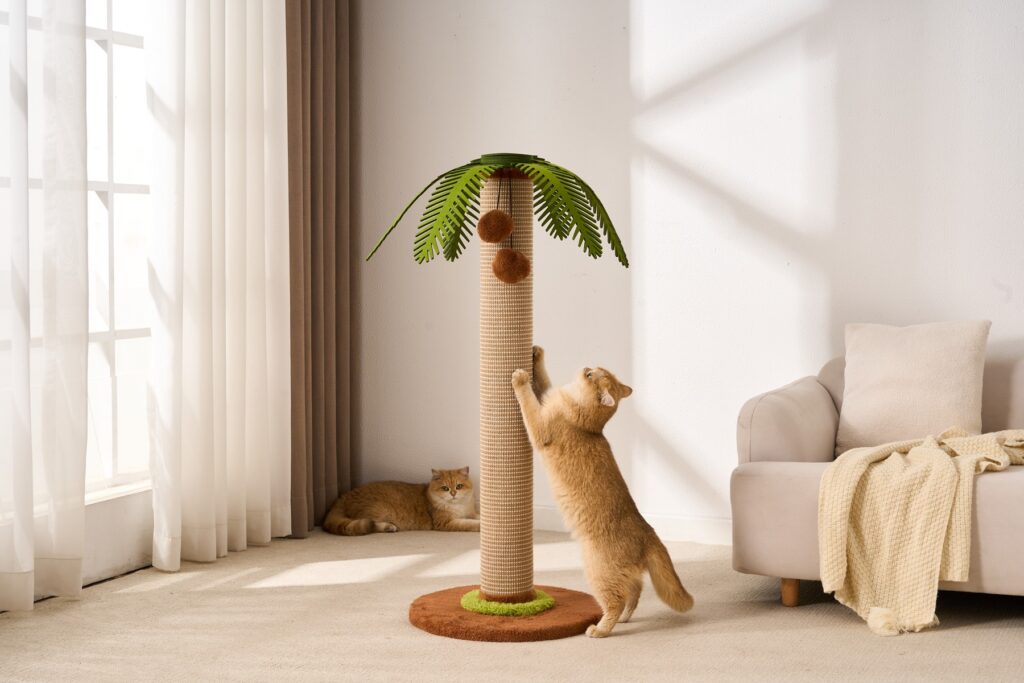
| Scratching sites are inconvenient | An accessible scratching section | A separate post near the usual target |
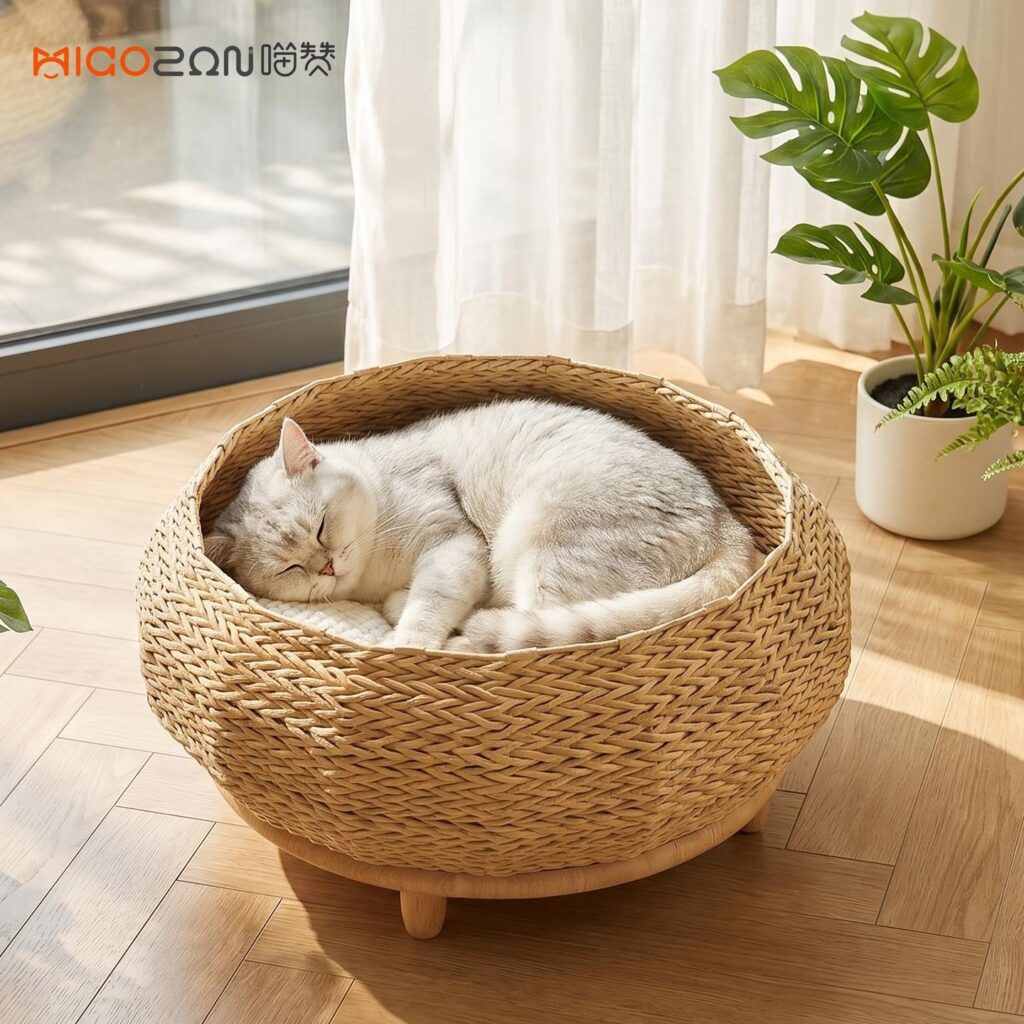
| Little sheltered resting space | An appropriately sized hide | A quiet covered bed |
| One cat controls the only route | Separate approachable resting places | Additional options in another room |
| Large jumps discourage access | Shorter, usable steps | A lower resting arrangement |
One tree may do several jobs, but inspect each function separately. A tower can have a comfortable bed while its scratching section is too obstructed for a full stretch. A good scratching post can sit below a tiny perch that does not suit your cat’s resting posture. Do not let the total number of features hide the quality of the one you actually need.
For a general explanation of elevated choices, see Ohio State University’s information on perches. It supports offering an elevated place to watch the surroundings. The exact furniture still needs to fit your room and your cat.
Check the descent before the top platform
Stand beside the proposed position and trace the route downward. Can the cat turn on each platform? Is there a clear lower step where it expects one? Does the final landing lead into an open floor area or onto a slippery object? A comfortable route makes the tree useful throughout the day, including when the cat is sleepy rather than playful.
Upper platforms should not encourage access to an unsecured window, curtain cord, or unsuitable shelf. A new tree can change what the cat can reach. Review the area above and beside it, not only the footprint below. Keep hanging blind cords and loose cables out of reach, and use appropriate window security.
Stability depends on correct assembly and placement. Follow the instructions for fixing, tightening, and any required anchoring. A tall design is not automatically unstable, and a short design is not automatically secure. Remove the tree from use if it rocks, has damaged connections, or cannot be installed as instructed.
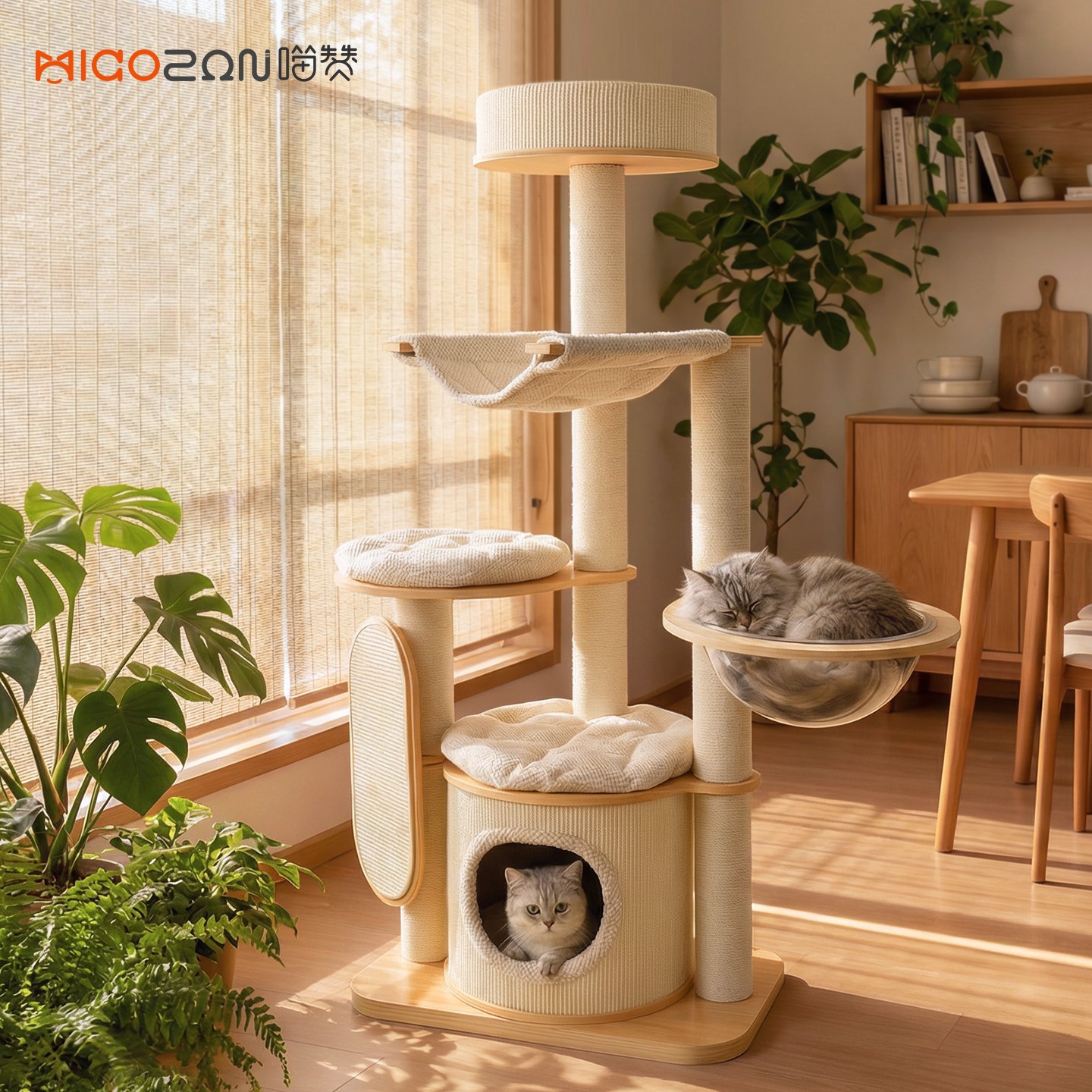
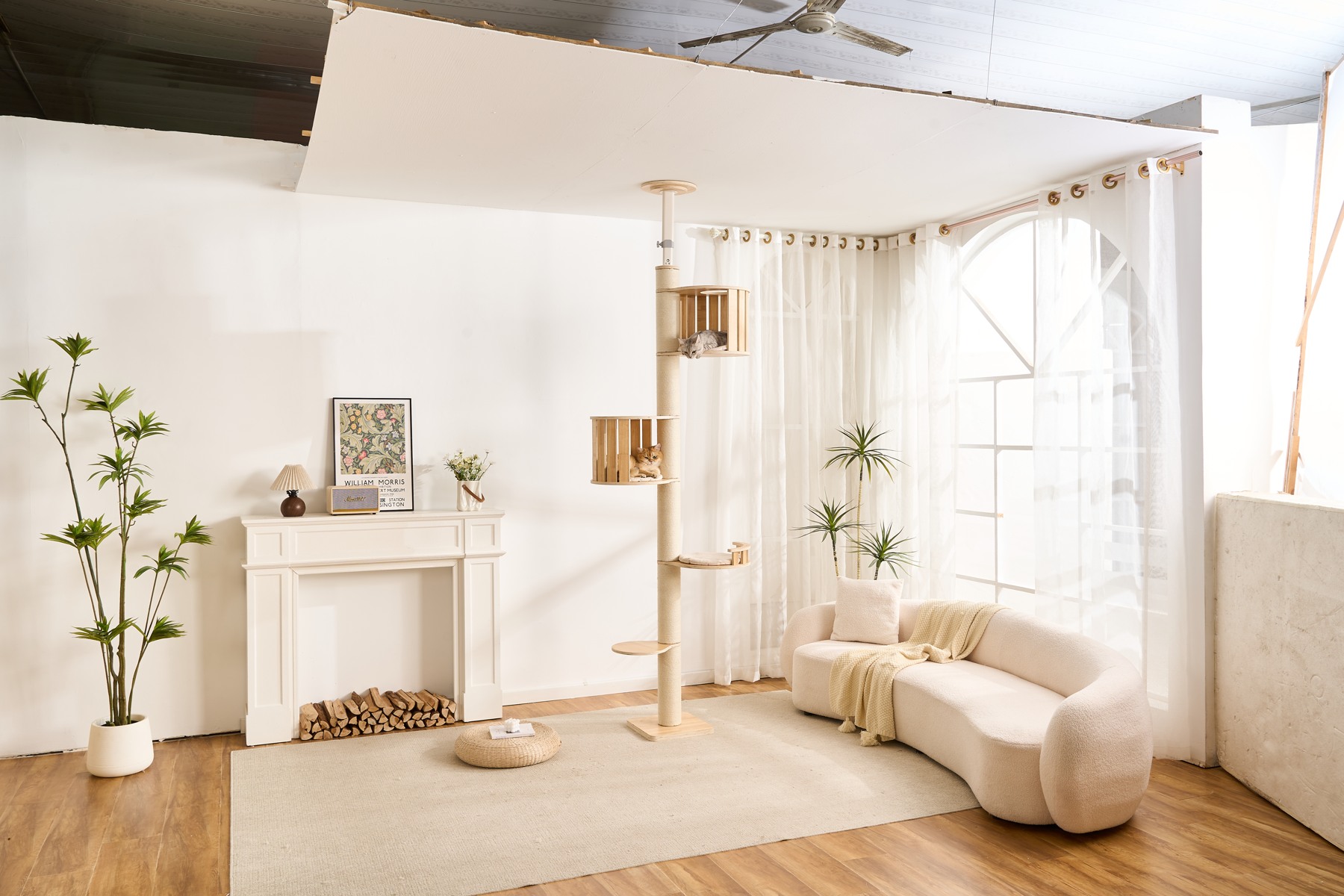
Miaomeng’s E01 Wooden Cat Tree and Treehouse Cat Tree show different arrangements to examine. Compare the visible routes, perches, and entrances, then confirm the exact dimensions and assembly requirements. Do not infer a suitable load limit or anchoring method from an attractive gallery image.
Keep play separate from passive furniture
A cat tree provides opportunities, but it does not replace interaction or other daily resources. A cat may enjoy sleeping on a perch and still need appropriate play, scratching choices, food, water, litter facilities, and undisturbed rest. Filling the room with climbing equipment cannot compensate for an arrangement that makes those basic resources hard to reach.
Use the tree as part of the room rather than as the center of every game. A short play session nearby can help a cat investigate, but avoid encouraging reckless leaps between high surfaces. Put wand toys and strings away when play ends. A dangling toy that looks decorative can become a hazard if it loosens or catches around a limb.
If the cat already uses the tree calmly, that is valuable use. It does not need to race up and down for the furniture to count. Resting, observing, and scratching can be the functions that matter most. Judge success by your cat’s comfortable behavior, not by how dramatic the climbing looks in a video.
Introduce one useful change
Place the tree in a familiar room with a clear approach. Leave the cat free to investigate without lifting it onto the top level. A reluctant cat needs an easy way to approach and retreat, not a demonstration of the highest platform. Familiar bedding may help where the product allows it, provided it does not create a slipping surface or block the route.
Keep the original resting choice available. You can learn more from voluntary use than from removing every alternative. If the tree remains empty, check whether the first step is convenient, the platform is large enough, and the position feels comfortable during normal household activity.
Review the arrangement after your cat has had several natural opportunities to use it. A tree hidden in an isolated room may not suit a cat that follows people. A tree beside a loud television may not suit a cat that leaves during evening viewing. Move thoughtfully and change one factor at a time so the result tells you something.
Spend according to the missing function
You do not need the tallest or most elaborate model to make a meaningful improvement. If the gap is an easy window view, a broad reachable perch may be the priority. If the problem is scratching beside the sofa, a standalone post can be more convenient than a tower whose post is behind a chair.
Measure the position, the route, and the resting area before comparing designs. Include cleaning access and the space people need to walk past. A product that fits everyday life is more likely to remain correctly positioned and maintained, which matters more than an extra feature that never gets used.
If you are considering a Miaomeng tree, send the model name, your available floor area, and the function you want to add through the form below. A simple description such as “a reachable resting perch beside the living-room window” makes comparison much clearer than asking which tree every cat needs.
Frequently asked questions
Do cats need cat trees if they can climb the sofa?
A sofa may provide one useful resting level, but review the whole environment. If there is no quiet elevated view or reliable scratching space, dedicated furniture may add something valuable. If the cat already has suitable choices, a tree is optional rather than a universal requirement.
Is a cat tree necessary in a small apartment?
It can be particularly useful when safe elevated space is limited. The tree still needs a clear approach, stable placement, and room for people to pass. Measure the full assembled shape instead of assuming a tall narrow design will fit everywhere.
Does a kitten need a very tall tree?
Height alone is not the goal. Look for appropriate access, usable platforms, and a manageable route down. Follow the product guidance and supervise early exploration. A lower arrangement may be more useful than an impressive top perch the kitten cannot comfortably reach.
Why does my cat use only one level?
That level may provide the preferred view, surface, temperature, or access. Check that the other levels are reachable and sound, but do not assume they must all be used. A single comfortable perch can still serve a worthwhile purpose.
Can a cat tree help in a home with several cats?
It can add choices, but several platforms on one narrow route are not always enough. Observe whether every cat can approach and leave comfortably. Separate resting locations may reduce competition more effectively than asking all cats to share one tower.
More from our resource center.
-

Do Cats Need Cat Trees? What Indoor Cats Need From Their Space
Do cats need cat trees? Review your cat's climbing, resting, scratching, and observation choices to see what a tree would add to your home.
Read Guide -
Cat Bed Buying Guide: Match the Bed to How Your Cat Sleeps
Choose a cat bed that suits your cat's sleeping position, usable space, entry needs, and cleaning routine, with practical checks before buying.
Read Guide -
Horizontal Cat Scratcher: Is It Right for a Carpet-Scratching Cat?
Choose a horizontal cat scratcher by watching your cat's posture, checking floor grip, and placing the pad where carpet scratching already happens.
Read Guide -
How to Choose a Scratching Post Your Cat Will Use
Learn how to choose a scratching post by matching scratching direction, surface, usable height, stability, and placement to your cat’s habits.
Read Guide -
Where to Put a Cat Tree: Find a Spot Your Cat Will Actually Use
Find where to put a cat tree by checking your cat’s routine, window safety, room layout, climbing access, and comfortable routes down.
Read Guide -
Reading model specifications and product galleries
Use the actual model name and parameter sheet to distinguish similar products in your sourcing list.
Read Guide
LET’S BUILD YOUR NEXT COLLECTION
Start with your market.
We’ll work through the details.
Send your selected models, target quantity and customization requirements.